Spotted Coralroot
corallorhiza maculata
Also known as: ["Spotted Coralroot Orchid","White Coralroot"]
Overview
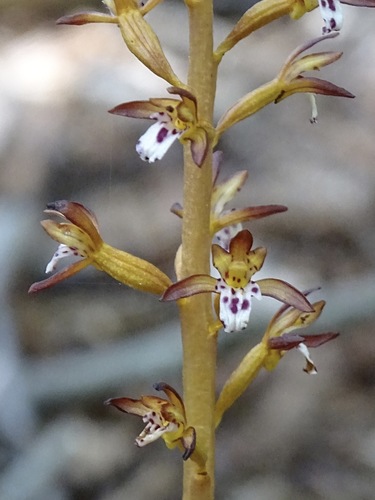
A mycoheterotrophic orchid lacking chlorophyll, relying on fungi for nutrients. It features spotted stems and reddish-brown flowers.
Benefits & Perks
["rare/collector’s item","wildlife attractant (bees, butterflies, birds)"]
Botanical Classification
| Phylum: | Magnoliophyta |
| Class: | Liliopsida |
| Order: | Asparagales |
| Family: | Orchidaceae |
| Genus: | Corallorhiza |
| Botanical Name: | Corallorhiza maculata |
Plant Characteristics
Basic Information
- Category: Flowers
- Suitable Location: wooded areas or shaded garden beds with rich, moist soil
- Suitable For:
- Is Weed: No
- Allergenicity: low
Environmental Needs
- Climate: {"temperatureRange":"0–30°C"}
- Hardiness: {"zones":"5–8"}
- Misting: not necessary, as it is adapted to natural humidity levels
- Drainage: Well-draining to fast-draining.
- Soil Type: Rich, well-draining, organic soil with high humus content; often found in forest litter.
Maintenance Level
- Maintenance Level: very high
- Toughness Level: very low
- Pruning Frequency: As needed, typically after flowering or when debris accumulates.
- Pruning Intensity: Light pruning only.
Care Details
Ideal Sunlight Coverage:
Partial shade to full shade; prefers dappled light or indirect light for 4–6 hours daily.
Sunlight Tolerance Tips:
Acclimate gradually to brighter light if moving from deep shade; avoid direct sunlight to prevent scorching; place in a sheltered spot outdoors or in a shaded indoor area.
Care Requirements
Care Difficulty
expert onlychallenging
Sunlight
partial shade to full shade
Avoid direct sun; provide dappled light; monitor for signs of stress.
Watering
every 7–10 days, allowing soil to dry slightly between waterings
Water infrequently; ensure excellent drainage; avoid waterlogged soil.
Soil
well-draining, humus-rich soil with decaying organic matter
pH: Slightly acidic to neutral (pH 5.5–7.0).
Ensure good drainage; maintain high organic content; avoid compacted soil.
Temperature
Cool to moderate temperatures, ideally 50–70°F (10–21°C); tolerates cooler conditions during dormancy.
Protect from frost; avoid extreme heat; mimic natural temperature cycles.
Fertilizing
rarely required, if at all, due to symbiotic relationship with fungi
Do not fertilize; rely on natural soil fungi; ensure no synthetic nutrients are applied.
Propagation
Methods
Division of rhizomes or spores (challenging); typically spreads slowly in the wild.
Step-by-Step Propagation Guide
- Carefully divide rhizomes.
- Plant in a suitable medium.
- Maintain high humidity and indirect light.
Best Time: Late summer to early fall, when the plant is dormant.
Environment
Cool, humid, shaded environment with consistent moisture.
Medium
Sphagnum moss or sterile potting mix with high organic matter.
Hormone
Not applicable; relies on mycorrhizal fungi for establishment.
Timeline
Slow; rhizome division may take 1–2 years to establish; spore propagation is highly variable.
Tools Needed
Sharp, sterile knife, small trowel, humidity dome.
Quick Tips
Ensure rhizomes have buds; maintain consistent moisture; be patient with growth.
Pruning & Repotting
Pruning Guide
Method
Snip dead or yellowing parts with clean cuts; avoid over-pruning.
Pruning Plan
Minimal pruning needed; focus on removing dead or damaged parts to maintain health.
Tools
Sharp, clean scissors or pruners.
Checklist
Use clean tools; remove only dead/damaged parts; avoid cutting healthy growth.
Repotting Guide
Best Season
Early spring, before new growth begins.
Pot Size
Use a pot only slightly larger than the current one; avoid excessive root space.
Method
Gently lift the plant; trim any dead roots; repot in a well-draining, organic mix; ensure minimal disturbance to the root system.
Suggestions
Rarely needed; only repot if the plant outgrows its container or soil quality degrades.
Checklist
Use a suitable soil mix; handle roots gently; ensure good drainage; avoid over-potting.
Advanced Care Tips
Watering Mastery
Watering Checklist
Check soil moisture before watering; water at the base; ensure drainage; reduce watering in dormancy.
How to Apply Water Properly
Water directly at the base of the plant, ensuring moisture reaches the root zone without saturating the soil. Water early in the day to allow foliage to dry.
Watering Schedule Tips
Water sparingly, allowing the soil to dry out between waterings. During dormancy, reduce watering significantly or cease entirely.
Soil Improvement
Add sphagnum moss, leaf litter, or well-rotted organic matter to enhance structure and fertility.
Temperature Stress Management
Signs of Temperature Issues
Wilting, chlorosis, or cessation of growth in extreme heat; mold or rot in excessive cold or dampness.
Cold Stress
Prolonged cold can cause root damage or dormancy issues; frost can kill above-ground parts.
Solution: Provide frost protection in cold climates; ensure good air circulation to prevent mold; allow the plant to enter natural dormancy.
Hot Stress
Excessive heat can lead to dehydration, wilting, or leaf burn, especially if combined with low humidity.
Solution: Provide shade during peak heat; increase humidity; water carefully to avoid overheating the roots.
Fertilizing Guide
Fertilizing Checklist
Avoid fertilizers; ensure mycorrhizal fungi are present; monitor for nutrient toxicity.
Fertilizing Method
Generally not required, as Corallorhiza maculata is myco-heterotrophic (derives nutrients from fungi); avoid fertilizing to prevent harm.
Common Problems & Solutions
Toxicity Warning
Cats
Non-toxicCorallorhiza maculata is not toxic to cats. The plant does not produce any known toxins that would harm feline health upon ingestion.
⚡ Toxic If:
if eaten
Dogs
Non-toxicCorallorhiza maculata is not toxic to dogs. The plant has no known adverse effects on canine health when ingested.
⚡ Toxic If:
if eaten
Humans
Non-toxicCorallorhiza maculata, commonly known as the spotted coralroot, is not considered toxic to humans. It is a myco-heterotrophic orchid that lacks chlorophyll and derives nutrients from fungi. There are no documented toxic effects associated with its consumption.
⚡ Toxic If:
if eaten
Frequently Asked Questions
Q: Is Corallorhiza maculata a true plant?
A: Yes, it is a true plant, but it is mycoheterotrophic, meaning it lacks chlorophyll and relies on fungi for nutrients.
Q: Can I grow Corallorhiza maculata in a typical garden?
A: It is extremely challenging to cultivate outside its natural habitat due to its reliance on specific fungi.
Q: Does Corallorhiza maculata produce flowers?
A: Yes, it produces reddish-brown flowers, typically in late summer or early fall.
Quick Reference
| Family: | Orchidaceae |
| Care: | expert only |
| Light: | partial shade to full shade |
| Water: | every 7–10 days, allowing so |
Get Expert Care Tips
Download the Plantious app for personalized care reminders and plant identification!
Google Play App Store